Forecast Misses Are Old News
REVENUE INTELLIGENCE
Forecast Misses Are Old News
By the time your forecast misses, the cause is two or three quarters old. Here is how leadership teams find out while there is still time to act.
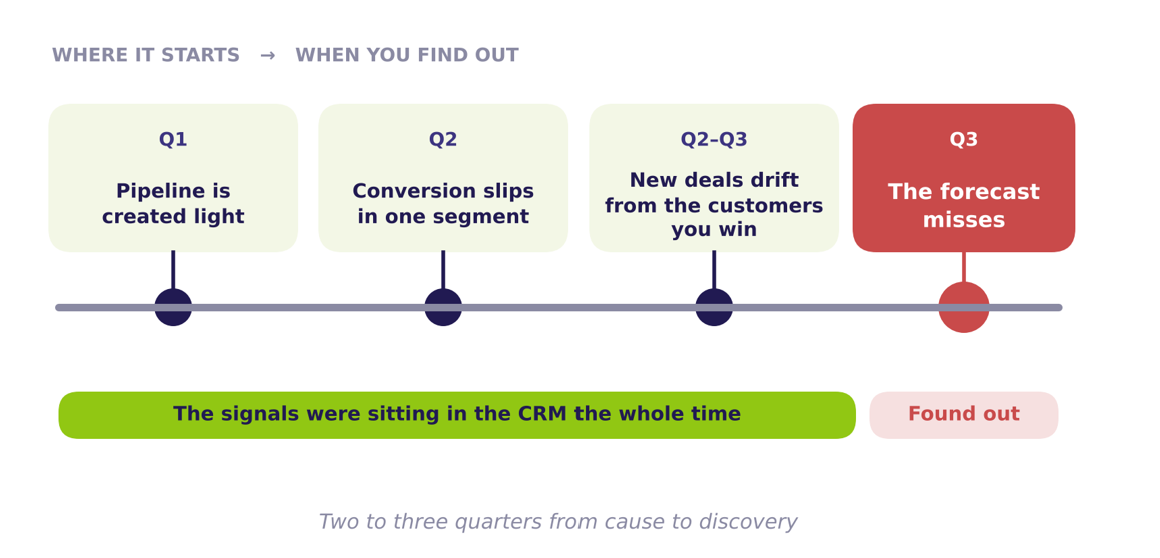
When does your leadership team find out about a revenue problem?
For most companies, it is the day the forecast misses.
By then, the cause is usually two or three quarters old.
The Cause Is Usually Two or Three Quarters Old
Look back at the last quarter that surprised you. The cause was rarely in that quarter. It usually traces to something that started earlier and looked like one of these three:
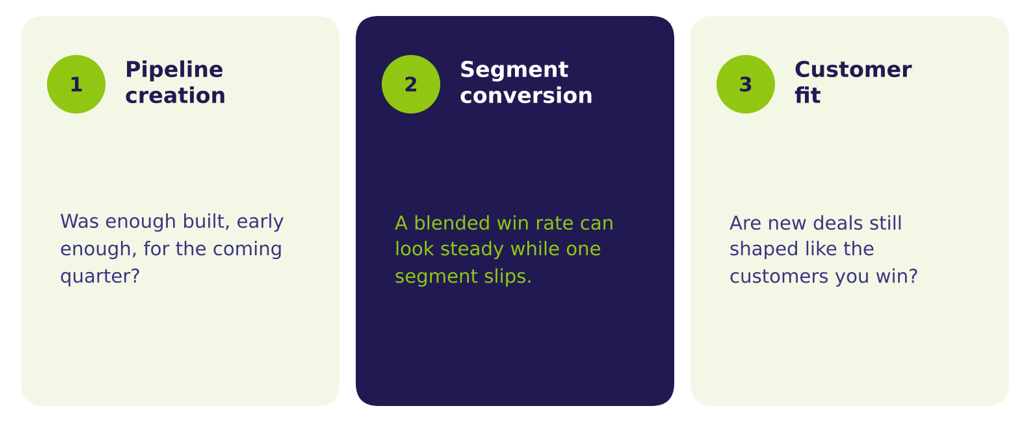
• Pipeline was created light. A quarter's revenue depends on pipeline built before the quarter begins. If Q1 produced too little, Q3 pays for it, and late-quarter effort can rarely close that gap.
• Conversion slipped in one segment. A blended win rate can look stable while one segment quietly weakens underneath it.
• New deals drifted away from the customers you win. Pipeline can look healthy in volume while filling up with deals that do not resemble the customers you actually win.
None of It Was Hidden
Here is the uncomfortable part for a founder or CEO. None of this was hidden. It was sitting in the CRM the whole time. Nobody was watching for it.
That changes the diagnosis. This is rarely a shortage of data. It is a gap in attention: the information exists, but no one's job is to compare it with what normal looks like and raise a hand when it moves.
Compare Against Your Own History
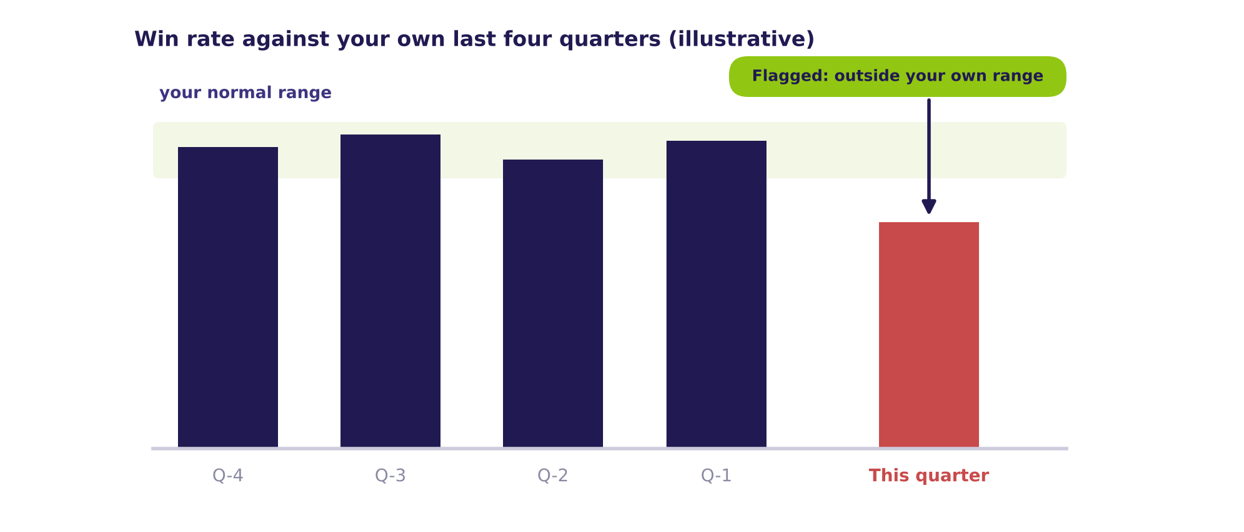
That is the gap the Outperform Revenue Intelligence platform, powered by SkyGeni, is built to close. It compares win rates, cycle times and pipeline creation against your own last four quarters, and flags what is off while you still have time to act.
Your own history is a practical yardstick because it reflects your market, your sales cycle and your customers rather than a generic average. When a number leaves your normal range, you learn that something changed in your business, and you learn it early.
What Finding Out Early Is Worth
The difference between learning about a problem in Q1 and learning about it in Q3 is the number of levers you still hold.
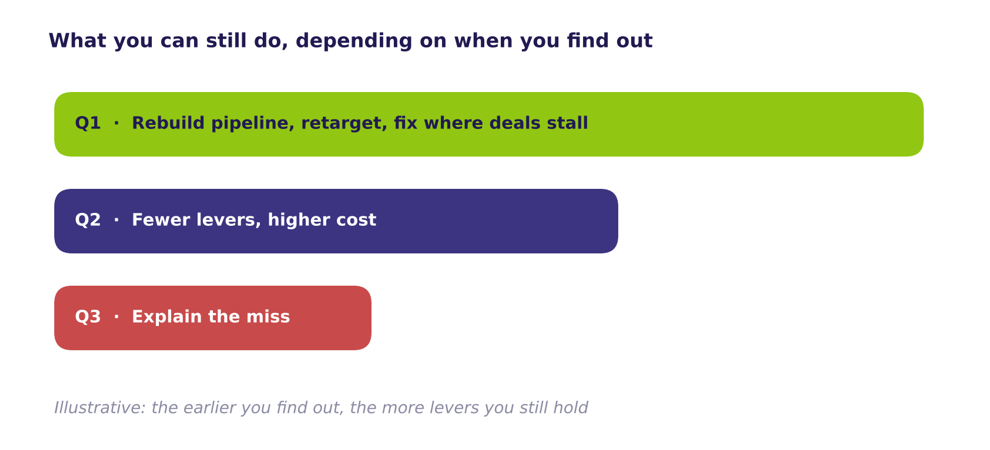
• Early: you can still change the inputs. Build more pipeline, retarget a segment, fix the stage where deals stall.
• Late: you can only explain the output to your board and your team.
Finding out early is the whole game.
Four Questions for Your Next Leadership Meeting
• Pipeline creation. How does the pipeline we have built for next quarter compare with our last four quarters?
• Segments. Has win rate moved in any single segment, even if the blended number looks fine?
• Cycle time. Are deals taking longer to close anywhere in the business?
• Customer fit. Do the deals we are creating now look like the customers we actually win?
If nobody in the room can answer these quickly, that is the gap.
The Bottom Line
A forecast miss is the final report on a problem that started long before. The question for a leadership team is not how to forecast better. It is how to find out sooner.
BOOK A FREE CALL Is your pipeline predictable, or are you hoping for the best? Custom HTML/CSS/JavaScript |

#SalesLeadership #RevenueGrowth #RevenueIntelligence
