
Listen with Empathy, Respond with Conviction
WHITE PAPER|FOR CEOs & SALES LEADERS
Listen with Empathy, Respond with Conviction
The Leadership Discipline That Makes Go-to-Market Change Stick
By Brian Taylor, Founder, Outperform Institute

Executive Summary
Most change initiatives inside a sales organization do not fail because people reject the destination. They fail because leadership underestimates what it costs people to leave behind the way they have always worked. The fix is not a better slide deck or a longer rollout plan. It is a discipline: listen to concerns with real empathy, then respond to those concerns with unwavering conviction about why the change must happen.
Empathy earns the right to be heard. Conviction gives people something solid to stand on once they have been heard. Leaders who master only one of the two either drift into appeasement or provoke resistance. Leaders who hold both, in that order, are the ones who see change take root.
The Resistance Is Rarely to the Change Itself
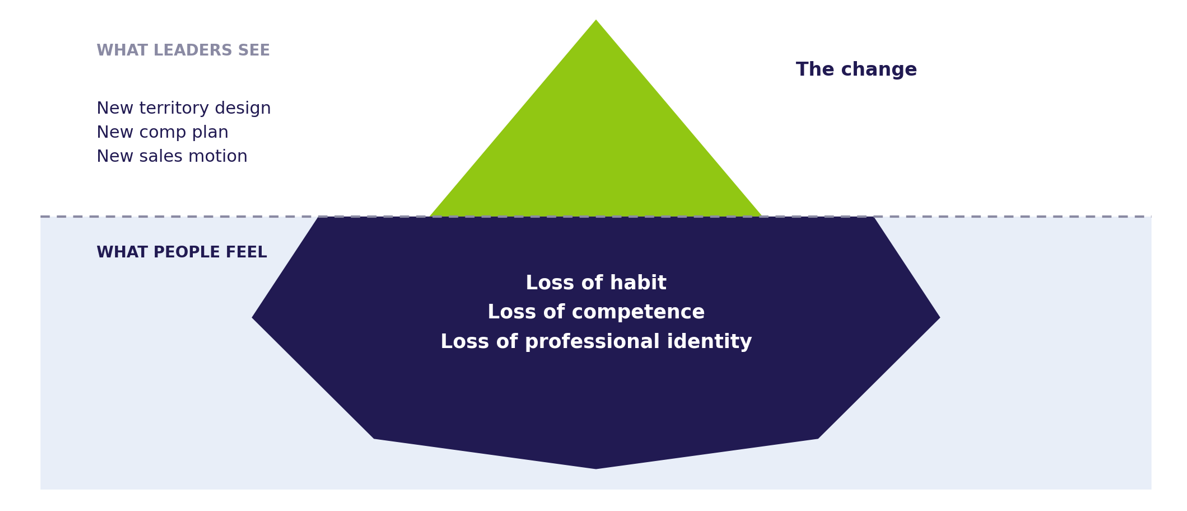
When a go-to-market transformation stalls, leaders usually diagnose it as resistance to the new model: the new territory design, the new comp plan, the new sales motion. That diagnosis is almost always incomplete. What people are reacting to is the demand to stop doing something they have done well for years and start doing something they have not yet proven they can do.
A tenured rep who has built a career on relationship selling is not defending a broken process when they push back on a new qualification framework. They are defending a professional identity built on being good at the old way. A regional manager who resists a new forecasting cadence is often not questioning the cadence itself. They are worried about being exposed by a level of visibility they have never had to operate under.
People rarely object to where the organization is going. They object to what they are being asked to give up getting there.
Leaders who treat this as a communication problem, and simply repeat the rationale louder or more often, miss the point. The rationale was never the barrier. The barrier is the disruption to habit, competence, and identity. Change management that only argues the business case, without acknowledging that disruption, will always run into more friction than the plan accounted for.
Two Disciplines, One Sequence
Leading change well requires both empathy and conviction. The order matters. Empathy comes first, because people cannot hear a case for the future while they are still processing what the present is costing them. Conviction comes second, because empathy without a firm answer to “why does this matter” leaves people validated but still lost.
Listen with Empathy
Listening with empathy means giving people room to name what they are losing, not just what they are being asked to do differently. It means asking questions that invite the real concern instead of the polished one: what is going to be hardest about this for you, what part of the old way are you going to miss, where do you think this breaks down.
This is not a listening tour for its own sake, and it is not a negotiation over whether the change happens. Its purpose is twofold. First, it surfaces genuine execution risk that the plan should account for, gaps in training, sequencing problems, dependencies leadership did not see. Second, and more importantly, it lets people feel understood rather than managed. A team that feels heard will still resist a bad plan, but a team that feels unheard will resist a good one just as hard.
Respond with Conviction
Once people have been heard, they need an answer, not just acknowledgment. Responding with conviction means reconnecting the change to why the business needs it and why the current path will not get the organization where it has to go. It is specific, it is honest about the tradeoffs, and it does not soften into “we'll see how it goes” the moment someone pushes back.
Conviction is not volume and it is not stubbornness. A leader can hold firm conviction and still say “that's a fair concern, and here is how we will address it” without walking back the decision itself. The distinction that matters is between adjusting how the change gets executed, which conviction allows, and reopening whether the change happens at all, which conviction does not allow.
Why Conviction Cannot Waver
This is the point where most change efforts actually break. It rarely fails in the kickoff meeting. It fails three or six weeks in, in a smaller room, when a member of the leadership team hedges. “I hear you, and honestly, I have some of the same concerns” said by a VP to a struggling manager sounds like empathy. To the organization, it reads as permission to wait the change out.
An organization does not calibrate its behavior to the official communication plan. It calibrates to the most tentative signal it can find from leadership, because that tentative signal is read as the truest one. One wavering leader, in one meeting, can undo months of disciplined rollout, not because the words were wrong but because they revealed that the leadership team's own conviction was not settled.
If leadership's conviction about why the change matters is not fully settled before the rollout begins, the organization will find that gap and live inside it.
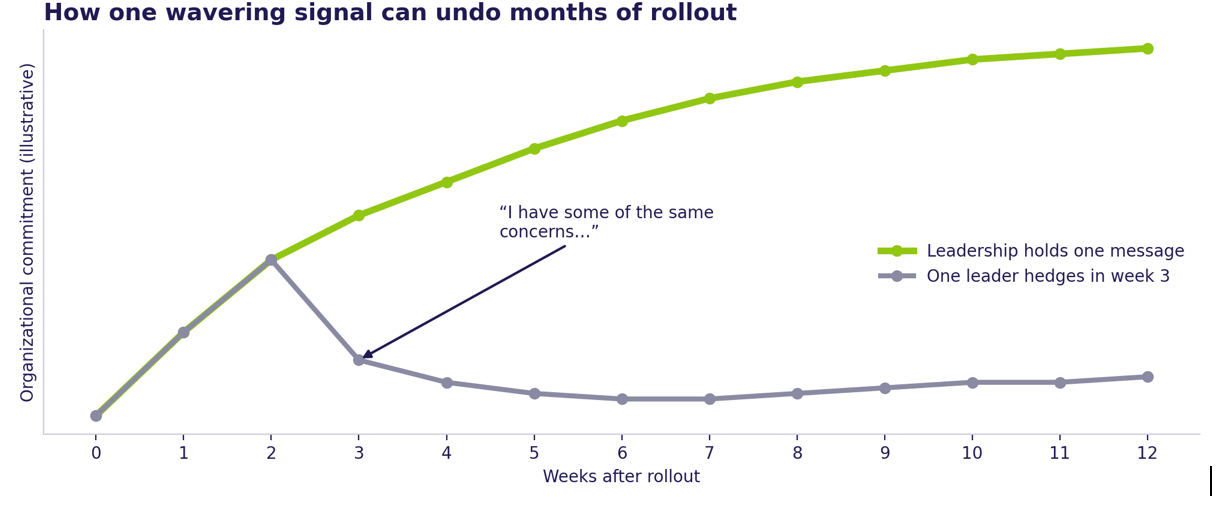
This is why alignment on the why belongs to the phase before launch, not the phase during it. Every leader who will be asked to hold the line needs to have argued the case out loud, in private, until their own doubts are resolved or surfaced as legitimate design flaws worth fixing before launch. What cannot happen is a leadership team that presents a united front publicly while privately still debating whether the change is right. That gap always leaks, and it leaks at the worst possible moment, in front of the people counting on leadership to be sure.
Putting the Discipline into Practice
A few disciplines separate leaders who hold this balance from leaders who drift toward one side or the other.
• Settle conviction before rollout. Resolve leadership's own doubts about the why in private, before the change is announced, not in front of the team while it is underway.
• Listen for the loss, not just the objection. Ask what people are being asked to give up, not only what they think of the new process.
• Separate execution feedback from resistance to change. Treat concerns about how the plan is built as signal worth acting on, and concerns rooted in the disruption of habit as expected, not as a reason to slow down.
• Respond with a why, not just a directive. Every time conviction is tested, restate the business case in specific terms, tied to what happens if the organization does not change.
• Hold the leadership team to one message. A single hedge from one leader is read by the organization as the real position of all of them. Conviction has to be a team discipline, not an individual one.
None of this replaces a sound plan. A poorly designed go-to-market change will still struggle no matter how well leadership listens or how firmly it holds conviction. But a well-designed change, led without this discipline, will struggle just as much. The plan gets the organization pointed in the right direction. Listening with empathy and responding with conviction is what gets it to actually walk there.
Conclusion
Change does not stick because people were told why it matters. It sticks because they were heard, and because the leadership asking them to change never gave them a reason to believe it might not mean it. Listen with empathy so people feel understood rather than managed. Respond with conviction so they have something firm to stand on once they have been heard. The moment leadership's own conviction wavers, even once, the organization will find that opening and the process will struggle to recover.

About the Author

Brian Taylor is a sales transformation leader and revenue growth strategist with more than two decades of experience building and leading high-performing commercial organizations, including roles as Chief Revenue
Officer and Senior Vice President of Sales. He is the founder of Outperform Institute, where he helps mid-market sales organizations grow revenue without adding cost or complexity, using the OutPerform Method to make performance measurable and results repeatable.
Learn more at outperforminstitute.online
BOOK A FREE CALL Is your pipeline predictable, or are you hoping for the best? . Custom HTML/CSS/JavaScript |