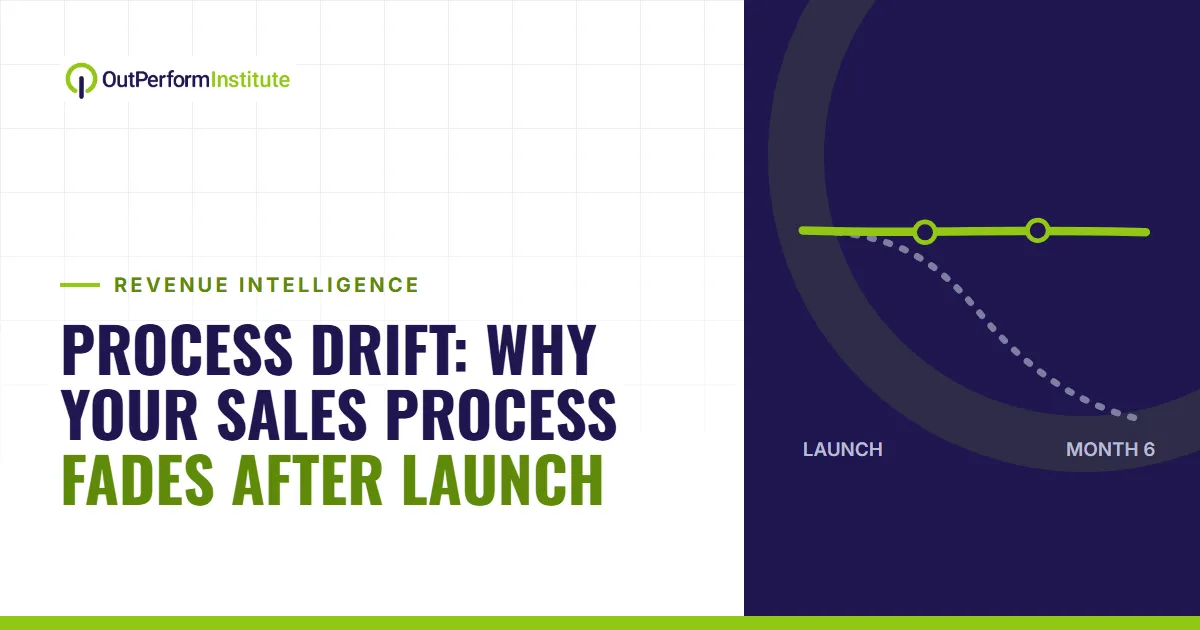
Process Drift: Why Your Sales Process Dies Six Months After the Consultants Leave
Most sales improvement projects share the same weak spot: the day the consultants leave. The process is installed. The team is trained. Pipeline looks clean. Then six months later, half of it has quietly faded, and nobody notices until the forecast misses. At OutPerform Institute, we call this process drift, and we built our engagement model to stop it.
A Process Doesn't Fail on Day One
How good systems fade slowly, one exception at a time
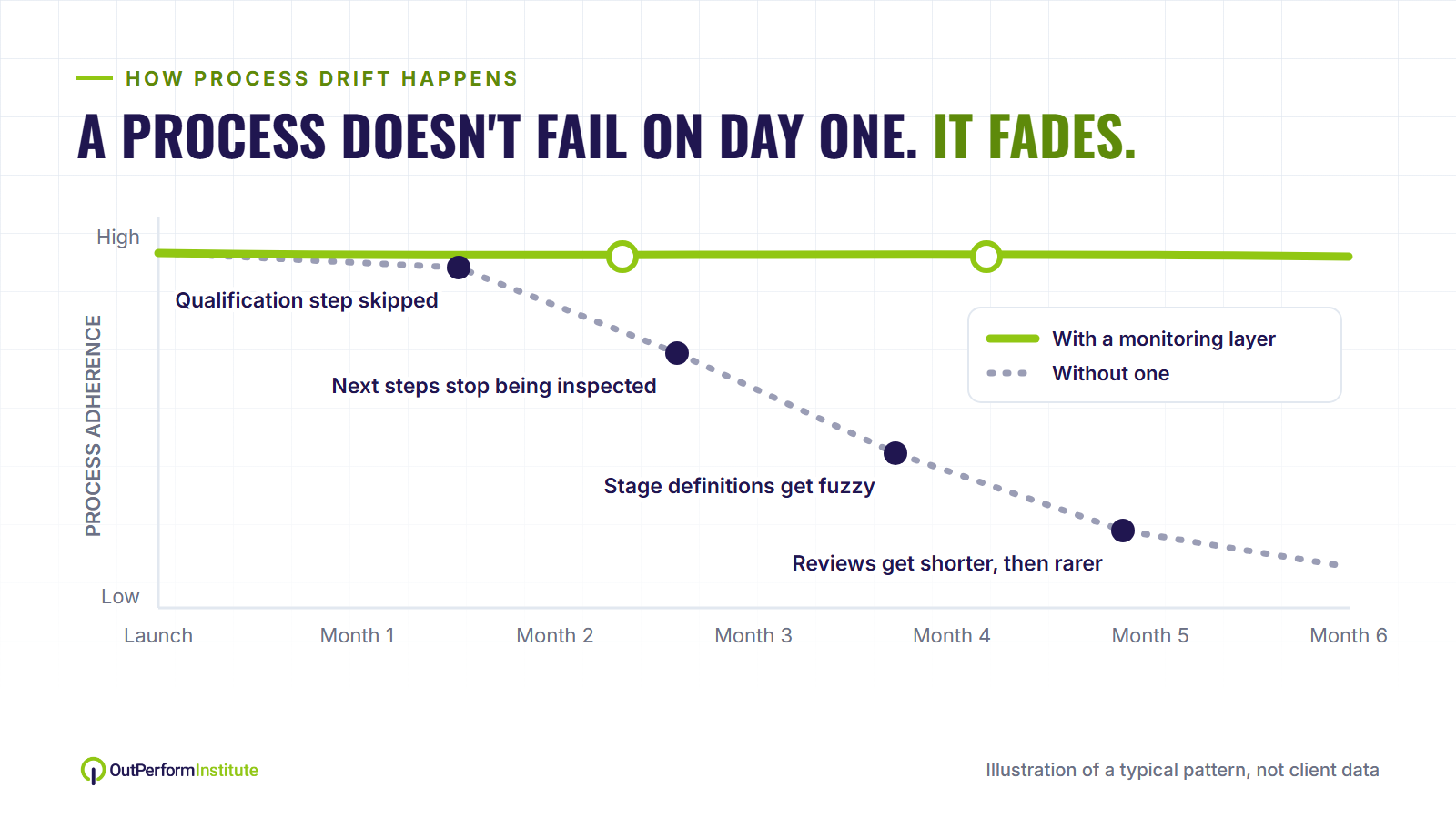
Our founder Brian Taylor has led sales teams for more than twenty years, and he has seen the same pattern again and again. A new sales process doesn't fail on day one. It fails slowly.
A rep skips a qualification step because the quarter is tight.
A manager stops inspecting next steps because the team "knows the drill."
Stage definitions get fuzzy.
Pipeline reviews get shorter, then less frequent.
Six months later, the process is still on the wall, but it's not in the pipeline.
Why Drift Happens
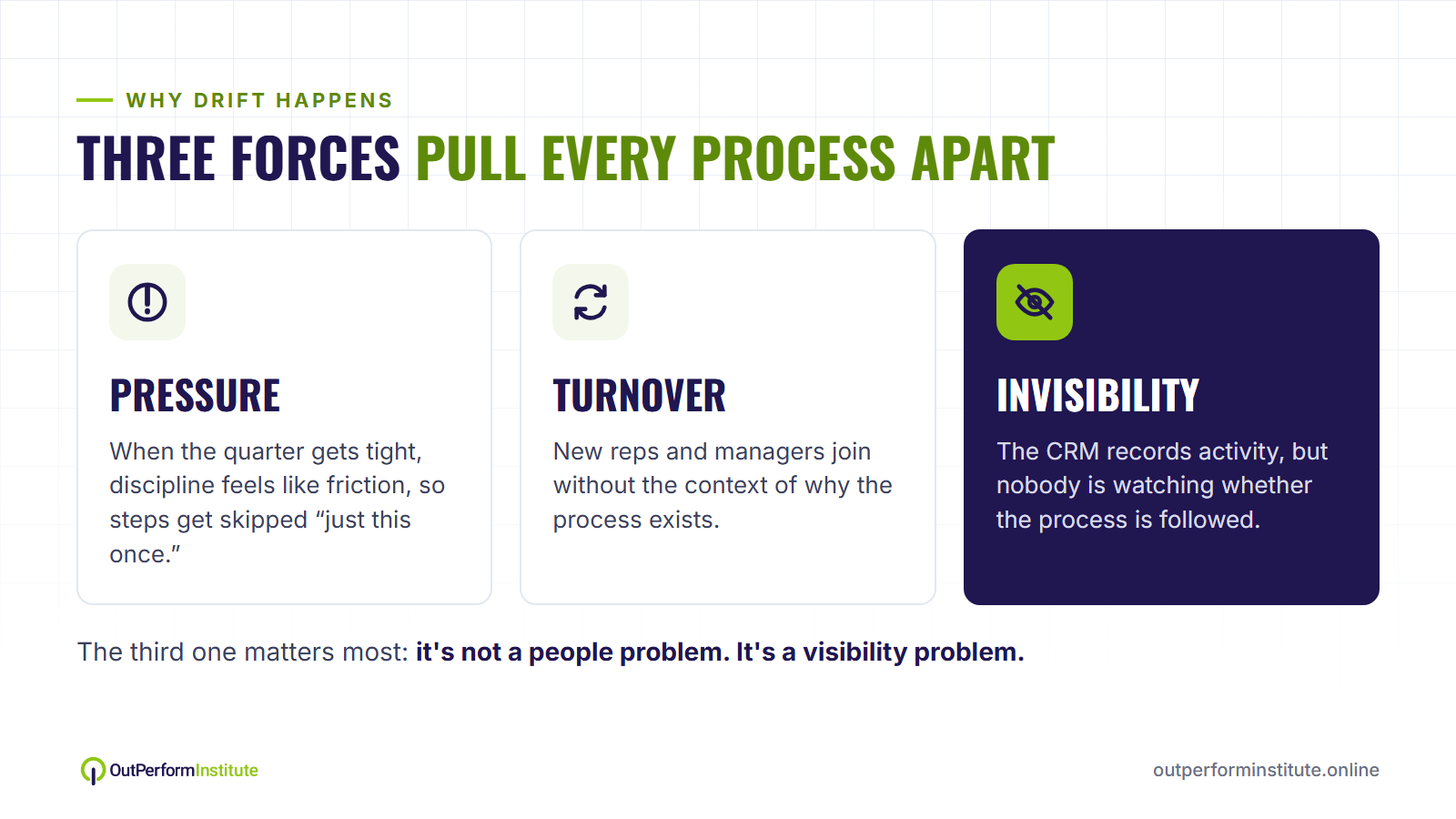
Drift isn't laziness. It's what happens to any system without feedback. Three forces drive it:
Pressure. When the quarter gets tight, discipline feels like friction, so steps get skipped "just this once."
Turnover. New reps and managers join without the context of why the process exists.
Invisibility. The CRM records activity, but nobody is watching whether the process is actually being followed.
That last one matters most. As Brian puts it: "That's not a people problem. It's a visibility problem."
The Cost of Finding Out Late
When does leadership usually discover a revenue problem? The day the forecast misses.
By then, the cause is often two or three quarters old. Pipeline was created light back in Q1. Conversion slipped in one segment. New deals drifted away from the customers you actually win.
None of it was hidden. It was sitting in the CRM the whole time. Nobody was watching for it.
How to Keep a System Enforced
Stopping drift takes two things working together: an operating cadence and instrumentation.
The operating cadence comes from the OutPerform Method's Shape pillar: performance review cadences, system iteration loops, and leadership reporting that make the system compound instead of decay.
The instrumentation comes from our Revenue Intelligence engagement, powered by SkyGeni. It's a permanent monitoring layer that integrates with your existing CRM and:
Sends automated alerts when deals or reps drift off-process
Gives continuous visibility into pipeline health and forecast risk
Compares win rates, cycle times, and pipeline creation against your own last four quarters
Keeps the system enforced after the embedded engagement ends
As Brian puts it: "Methodology without instrumentation is a well-run guess. Instrumentation without methodology is a dashboard nobody acts on. You need both."
Explainable Signals, Not Black Boxes
Most sales dashboards have the opposite problem: so many alerts that everyone ignores them. The AI agents inside the platform check key revenue metrics every hour, including win rate, conversion, cycle time, deal size, coverage, and next-quarter pipeline build. But they only fire when a change is both statistically unusual and big enough to matter. Low-volume noise gets suppressed, and slow quarter-over-quarter decline gets flagged early as a trend. As Brian puts it: "Loud about real problems. Quiet about noise."
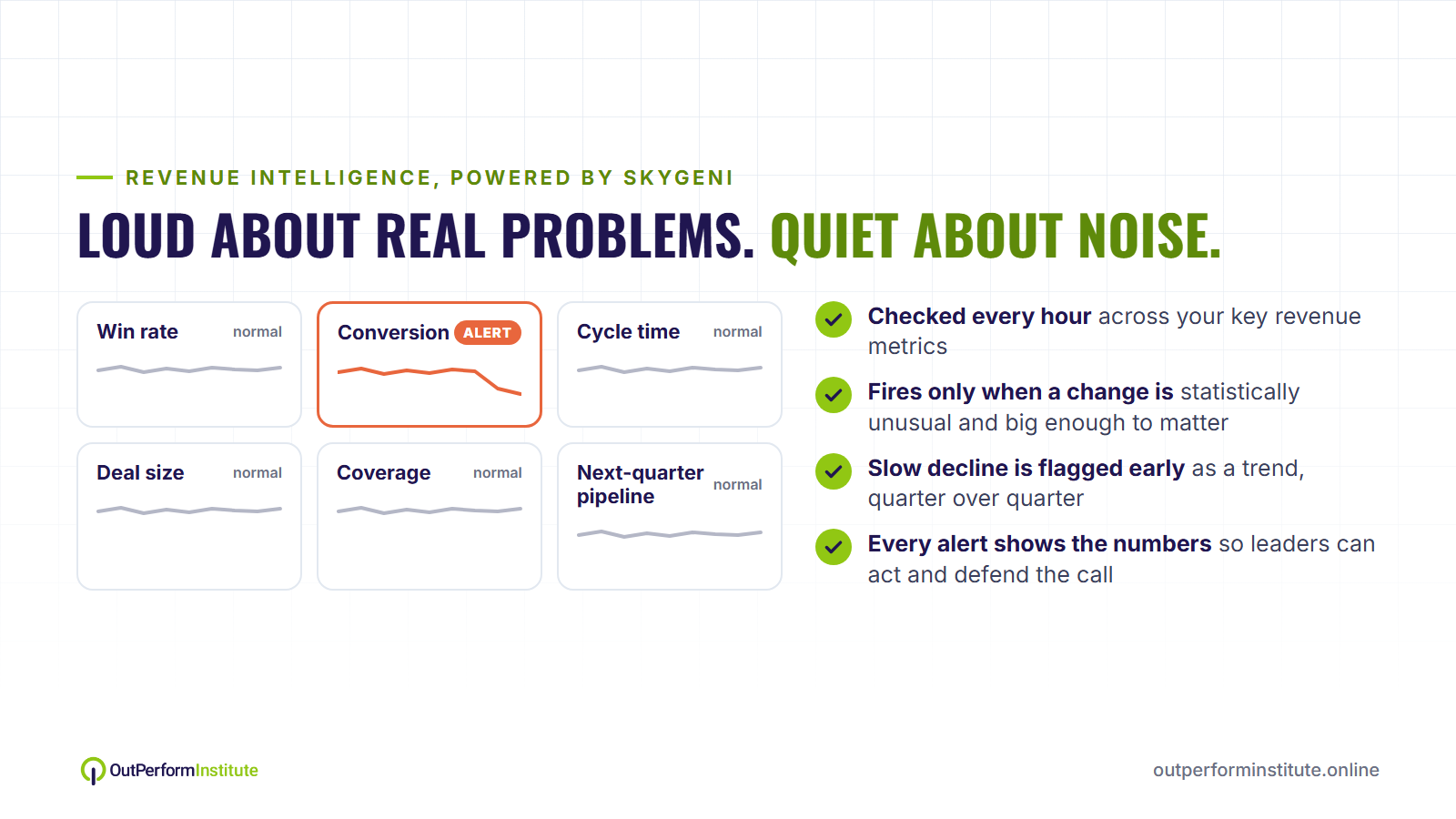
Leaders also don't act on alerts they don't understand. That's why we partnered with SkyGeni, whose Explainable AI shows the reasoning behind every signal: which behaviors, fields, and patterns drove it, and how they compare to past wins and losses.
So a leader doesn't just learn that the quarter is at risk. They can see early that conversion dropped in one segment, understand what's driving it, and use the management cadence to act while there's still time to change the number.
What We Install, and What We Leave Behind
Our engagement architecture is built so the work lasts:
Diagnostic: we score the system across all five pillars and quantify where revenue is leaking.
Installation: we embed with your team to build the forecast rules, pipeline architecture, and accountability.
Management and monitoring: review cadences and revenue intelligence keep the system enforced as it compounds.
The goal is simple: what gets measured improves, and what gets systematized scales.
Looking Ahead
The real test of any sales improvement isn't how it looks at launch. It's how it looks two quarters later.
So here's the question worth asking: which part of your sales process has quietly drifted since you last checked?
If you'd like to see what drift looks like in your own data, let's take a look together.
Founder & CEO level · No pitch
