Your CRM Is a System of Opinions: Stop Paying the Confidence Tax
REVENUE FORECASTING|FOR CEOs & BUSINESS OWNERS
Your CRM Is a System of Opinions, and Your Forecast Is Paying the Confidence Tax
Why “90% closed” usually means nothing, and what it costs the company when the number reaches your board deck without proof behind it.
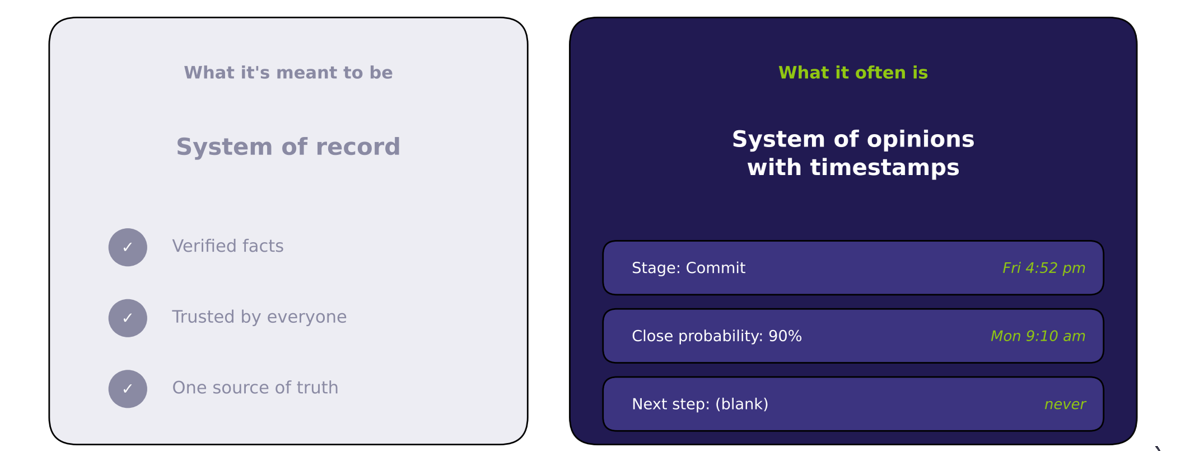
Your CRM isn't a system of record. It's a system of opinions with timestamps.
If you run the company, you probably recognize the feeling. The dashboards are full, the fields are populated, and yet when a number matters, nobody quite trusts it. This post is about the two places that distrust does the most damage: the data in your CRM, and the forecast built on top of it.
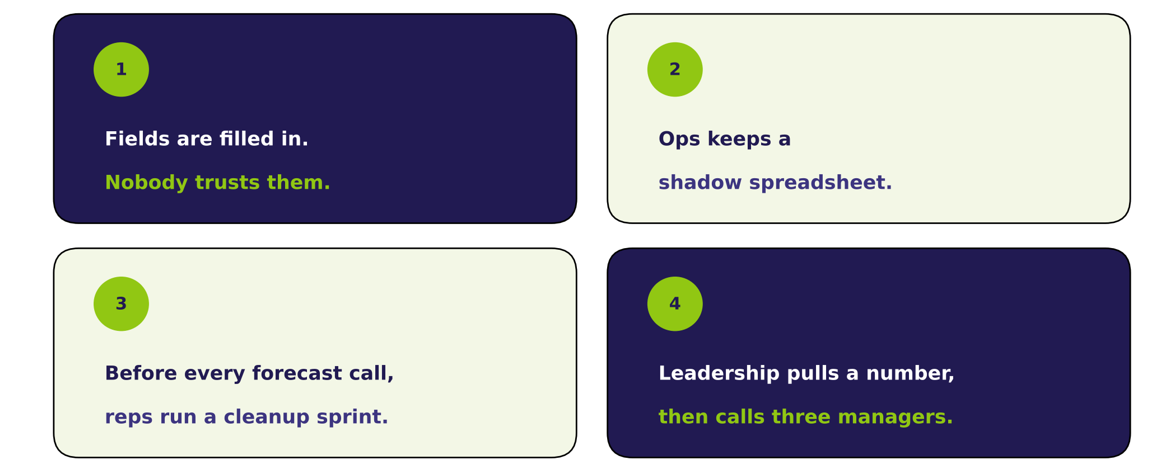
What a Score 5 CRM Looks Like
Fields are filled in. Nobody trusts them. If any of the following sounds familiar, your data is working against you.
The Cost: Every Decision Becomes Negotiable
When the data cannot be trusted, everything built on it becomes open to argument. Territory design. Capacity planning. Coverage math. The forecast.
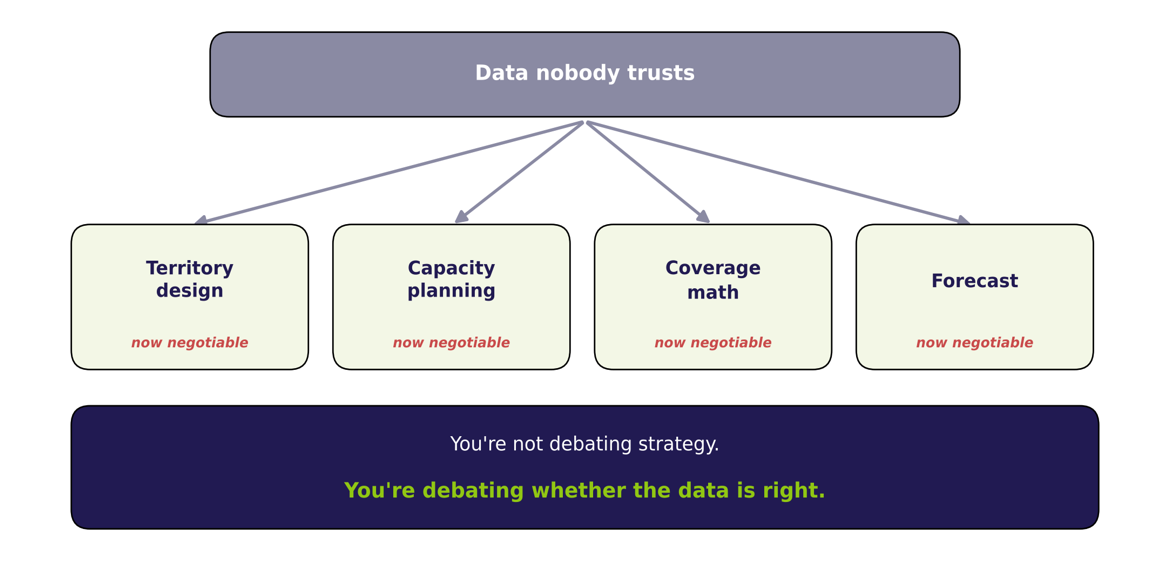
You are no longer debating strategy. You are debating whether the data is right. That argument burns weeks, and nobody wins it, because no one can prove their version.
Poor data quality leads to poor decisions. Not eventually. Immediately.
“It’s 90% Closed.” What Does That Mean?
A rep tells you a deal is 90% closed. What does that number actually mean?
Usually nothing. It means they feel good about it.
Confidence is not evidence. But most forecasts are built almost entirely out of confidence, dressed up as a percentage.
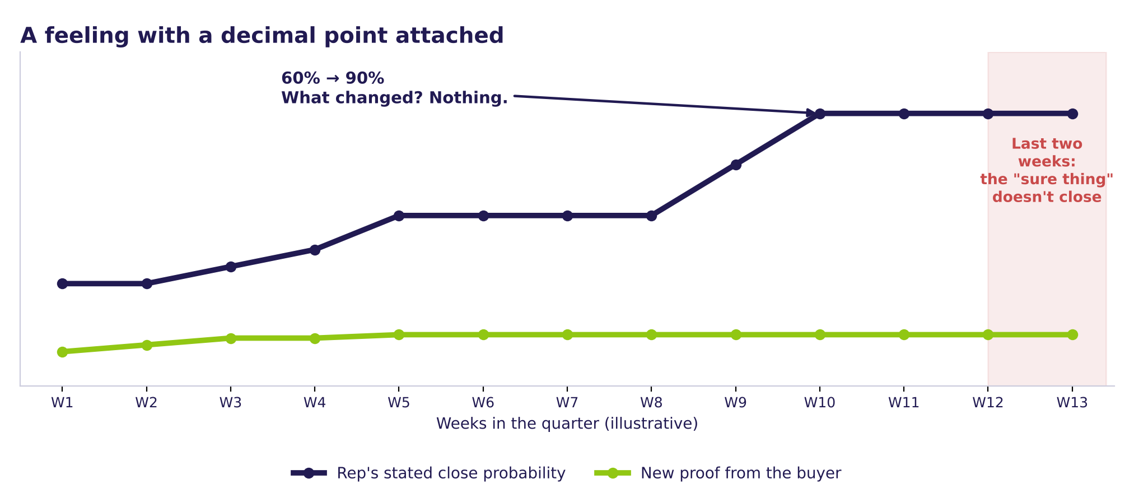
Ask what moved the number from 60 to 90. Most of the time the answer is silence. No new signer engaged. No next step booked. Nothing changed except the rep’s gut. It is a feeling with a decimal point attached.
The Confidence Tax
We call this the confidence tax. Every forecast built on feel instead of proof pays it eventually, usually in the last two weeks of the quarter, when the “sure thing” does not close and nobody can explain why.
For a CEO, the tax is rarely just one lost deal. It is the hiring plan built on revenue that did not arrive, the board conversation that goes badly, and the credibility spent explaining a miss that was visible in the data weeks earlier.
The Fix Is Not Asking Reps to Be More Honest
Most reps are not lying. They are doing what an unstructured process allows them to do. The answer is not a speech about honesty. It is removing the ability to guess.
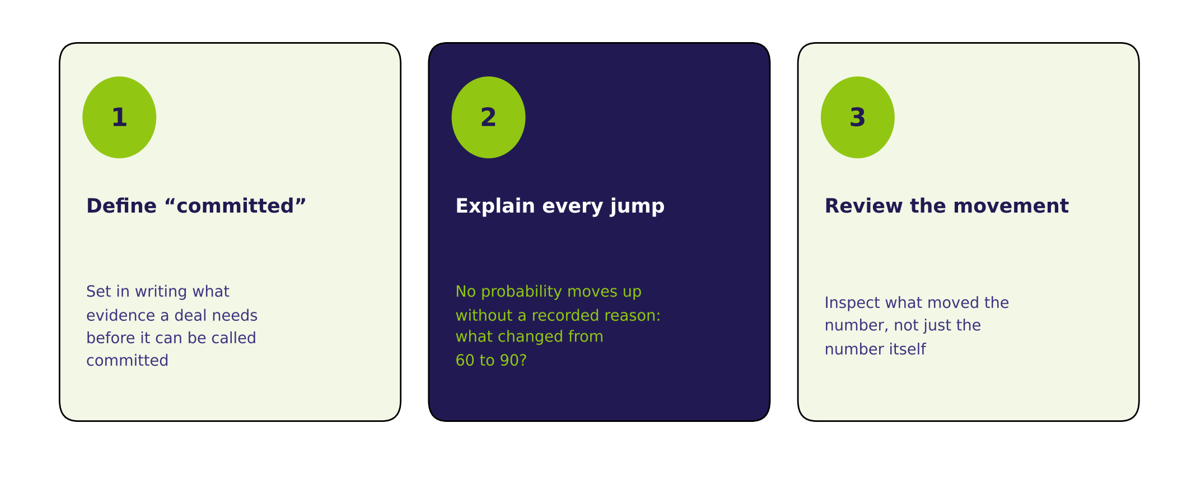
That takes three specific changes to how commits get made in your organization, starting with what “committed” is even allowed to mean.
1. Define what “committed” means
Write down the evidence a deal must have before it can be called committed. Not how confident the rep feels, but what has actually happened with the buyer.
2. Require a reason for every jump
When a probability moves up, the reason gets recorded. If the honest answer to “what moved this from 60 to 90?” is nothing, the number does not move.
3. Review movement, not just totals
Inspect what changed in the forecast since last week, and why. A flat total can hide a lot of churn underneath, and a rising one can be built on nothing.
Control Is About Proof, Not Tighter Reins
Control isn’t about tightening the reins. It’s about replacing opinion with proof before the number ever reaches your board deck. When the CRM is trusted and the commit means something, leadership stops spending its time verifying and starts spending it deciding.
What’s the last forecast surprise that cost you a quarter? I would like to hear it.
BOOK A FREE CALL Is your pipeline predictable, or are you hoping for the best? Custom HTML/CSS/JavaScript |